Home
Editor-in-Chief
Prof. Jun Ho Oh
Automatic Control, Mechatronics, Robotics
Korea Adv. Inst. of Sci. & Technol.
Daejeon 34141, South Korea
Co-Editors-in-Chief
Prof. Eric T. Matson
Purdue Univ.
USA
Prof. Hyun Myung
Civil & Env. Eng.
Korea Adv. Inst. of Sci. & Technol.
Daejeon 34141, South Korea
Prof. Changbin (Brad) Yu
Westlake Institute for Advanced Study(WIAS)
Australia Nat'l Univ.
China, Australia
Managing Editor
Prof. Chang-Koon Choi
Korea Adv. Inst. of Sci. & Technol.
Daejeon 34141, Korea
ISSN:2287-4976 (Print) ISSN:2287-4984 (Online)
Vol.3 (4 issues) for 2021, Quarterly
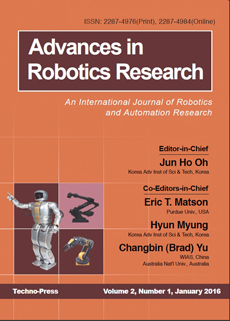
Aims and Scope
The "Advances in Robotics Research" aims at providing an integrated source of information for academics and engineers in the field of Robotics and Automation. With a wide variety of topics covered by the journal, the readers may be benefit from an integrated single source of information to know the current developments in the allied field and to use it in future research and application.
- Automation;
- Biologically-Inspired Robots;
- Bio-Robots;
- Cellular, distributed, cooperating Robotics
- Haptics;
- Humanoid Robots;
- Human-Robot Interaction;
- Industrial robots;
- Kinematics and Control of Robot;
- Medical Robotics;
- Micro/Nano, Electro-Mechanical Systems and Robots;
- Personal and Service Robotics;
- Robot Design;
- Robot motion planning, path and trajectory planning, localization and navigation;
- Robotics and Computers;
- Robotics in Intelligent vehicle and highway systems;
- Sensors and Actuators;
- Space and Unmanned air Robots;
- Tactile and other contact sensing systems; -Underwater Robots;
- Teleoperation and telerobotics;
- Virtual reality;
- Vision and other non-contact sensors;
Editorial Board
Prof. Ayman Abbas
Prof. Adel Akbarimajd
Prof. John Anderson
Dr. Joonbum Bae
Prof. Farah Bouakrif
Prof. Dongxing Cao
Prof. Donghwa Lee
Prof. Venketesh N Dubey
Dr. Jaime Gallardo-Alvarado
Prof. Yisheng Guan
Prof. Haemin Jeon
Prof. Maki K. Habib
Prof. Hesuan Hu
Dr. Javier Ibanez-Guzman
Prof. Seul Jung
Dr. Tamas Kalmar-Nagy
Prof. Mohamed Salah Khireddine
Dr. Ayoung Kim
Prof. Gon-Woo Kim
Dr. Jonghoek Kim
Prof. Young J. Kim
Prof. Jinwhan Kim
Prof. Takashi Kubota
Prof. Jaerock Kwon
Dr. Michele Lanzetta
Prof. C.S. George Lee
Prof. Joo-Ho Lee
Prof. Jadran Lenarcic
Prof. Zhijun Li
Dr. Huashan Liu
Prof. Eric T. Matson
Prof. Antonio Mendes Lopes
Prof. Said Megahed
Dr. Amir Ali Amiri Moghadam
Prof. Antonio J. R. Neves
Prof. Paul G. Ranky
Prof. Jose Santos Reyes
Dr. Dmitry A. Rogatkin
Prof. TaeWon Seo
Prof. Seungmok Lee
Dr. Dimitar Stefanov
Prof. Liying Su
Prof. Prahlad Vadakkepat
Prof. G-C Vosniakos
Prof. Zhong-li Wang
Dr. Zhouyi Wang
Prof. Yaoyao Wang
Prof. Youmin Zhang
Prof. Jun Wu
Prof. Peter Xu
Dr. Qingsong Xu
Prof. Woosoon Yim
Prof. Changbin (Brad) Yu
Prof. Poramate Manoonpong
Guide to Authors
Techno-Press Guide to Authors (2026) — applies to all journals. Open in new tab
If the document does not appear, use “Open in new tab” or download the PDF.
Ethics
All the editors, publishers, researchers, and peer reviewers of Techno-Press journals strongly encourage to carefully review and follow the Committee on Publication Ethics (COPE) guidelines: https://publicationethics.org/guidance/Guidelines. (https://publicationethics.org/guidance/Guidelines)
Authorship credit should be based on
(1) Substantial contributors to the conception or design of the work or the acquisition, analysis
or interpretation of data for the work,
(2) Drafting the work or revising it critically for important intellectual content,
(3) Final approval of the version to be published, and
(4) Agreement to be accountable for all aspects of the work in ensuring that questions related
to the accuracy or integrity of any part of the work are appropriately investigated and resolved.
Authors should meet these four conditions after the initial submission of a manuscript and any changes whatsoever in authorship (adding author(s), deleting author(s), or re-arranging the order of authors) must be explained by a letter to the editor from the authors concerned. This letter must be signed by all authors on the paper. Techno-Press does not correct authorship after the final acceptance unless a mistake has been made by the editorial staff. Authorship may be changed before the final acceptance when the authorship correction is requested by all of the authors involved with the manuscript.
The corresponding author takes primary responsibility for communication with the journal during the manuscript submission, peer review, and publication process. The corresponding author should be available throughout the submission and peer review process to respond to editorial queries in a timely manner, and should be available to respond to critiques of the work and cooperate with any requests from the journal for data or additional information or questions about the paper even after publication.
Submitted manuscripts must not have been previously published or be under consideration for publication elsewhere. No part of the accepted manuscript should be duplicated in any other journal without the permission of the Editorial Board. Submitted manuscripts are checked for possible plagiarism or duplicate publication upon the paper’s arrival. If plagiarism or duplicate publication is detected, the manuscripts may be rejected, the authors will be announced in the journal, and their institutions will be informed. There will also be penalties for the authors. A letter of permission is required for any and all material that has been published previously. It is the responsibility of the author to request permission from the publisher for any material that is being reproduced. This requirement applies to text, figures, and tables.
The corresponding author must inform the editor of any potential conflicts of interest that could influence the authors’ interpretation of the data. Examples of potential conflicts of interest are financial support from or connections to companies, political pressure from interest groups, and academically related issues. In particular, all sources of funding applicable to the study should be explicitly stated.When the journal faces suspected cases of research and publication misconduct, such as redundant publication, plagiarism, fraudulent or fabricated data, changes in authorship, undisclosed conflict of interest, ethical problems with a submitted manuscript, appropriation by a reviewer of an author’s idea or data, and complaints against editors, the resolution process will follow the flowchart provided by COPE, https://publicationethics.org/guidance/Flowcharts. (https://publicationethics.org/guidance/Flowcharts)
The discussion and decision on the suspected cases are carried out by the Editorial Board.
The Editorial Board will continuously work to monitor and safeguard publication ethics:
* Guidelines for retracting articles;
* Maintenance of the integrity of academic records;
* Preclusion of business needs from compromising intellectual and ethical standards;
* Publishing corrections, clarifications, retractions, and apologies when needed; and
* Excluding plagiarized and fraudulent data.
The editors maintain the following responsibilities:
* Responsibility and authority to reject and accept articles;
* Avoid any conflict of interest with respect to articles they reject or accept;
* Promote the publication of corrections or retractions when errors are found; and
* Preserve the anonymity of reviewers.