Home
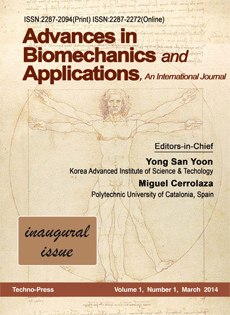
Editors-in-Chief
Prof. Yong San Yoon ysyoon@kaist.ac.kr
Department of Mechanical Engineering, Korea Advanced Institute of Science & Tech. Daejeon 305-701, South Korea
Prof. Miguel Cerrolaza mcerrolaza@cimne.upc.edu
Int'l Center for Numerical Methods in Eng. Polytechnic University of Catalonia 08034 Barcelona, Spain
Prof. Sukyung Park sukyungp@kaist.ac.kr
Department of Mechanical Engineering KAIST, Science town Daejeon, 305-701, South Korea
Regional editors
Prof. Taiji Adachi adachi@frontier.kyoto-u.ac.jp
Dept. of Biomechanics Kyoto University Kyoto 606-8501, Japan
Prof. Assad Oberai oberaa@rpi.edu
Dept. of Mech., Aerosp. & Nuclear Eng.Rensselaer Polytechnic Institute Troy, NY 12180, USA
Prof. Manuel Doblaré manuel.doblare@research.abengoa.com
Abengoa Research c/Energía Solar 1, Palmas Altas 41014 Seville, Spain
Associate Editors
Prof. Ernst Rank ernst.rank@tum.de
Faculty of Civil Engineering and Geodesy Technische Universität München Arcisstr. 21, 80290 Munich, Germany
Prof. Anthony Petrella apetrell@mines.edu
Dept. of Mech Eng. Colorado School of Mines Golden, Co 80401, USA
Managing Editor
Prof. Chang-Koon Choi cck@kaist.ac.kr
Korea Advanced Institute of Science & Technology Daejeon 305-701, Korea
ISSN:2287-2094(Print) ISSN:2287-2272(Online)
Vol. 2(4 issues) for 2015, Quarterly
Aims and Scope
The Advances in Biomechanics and Applications (ABA), An International Journal, reports the original contributions in applying biomechanics, biomaterials and biomedical principles to biological systems and biological phenomena. These areas are emerging and rapidly growing fields attracting more engineers and specialists in several branches. The journal aims at providing a forum of excellence, based on a widely disseminated publication, for all researchers interested in this interdisciplinary and promising area of engineering and applied sciences. The journal may cover;
- Biomechanics,
- Modeling/simulation/visualization,
- Medical applications,
- Biomedical engineering,
- Biomaterials,
- Medical devices,
- Living tissues/muscles/organs,
- Nerves,
- Fluid/blood dynamics,
- Bone/bone mechanics/ossification,
- Other relevant topics.
Editorial Board
Prof. A Al-Jumaily
Prof. D. Ambrosi
Prof. F. Auricchio
Prof. B. Castañeda
Prof. T. David
Prof. J. Di Paolo
Prof. Agnes Drochon
Prof. R Dumas
Dr. C Falcó
Prof. P. Fernandes
Prof. C. Gasser
Prof. M. Gee
Prof. J. Goicolea
Prof. P. Gomis
Dr. T. Guess
Prof. S. Gupta
Prof. M Martín-Landrove
Prof. M Mesnard
Prof. Y Morsi
Dr. S Müftü
Prof. R Natarajan
Prof. N. Nuno
Prof. D. Pioletti
Prof. A Qiao
Prof. L Rakotomanana
Prof. H. Rodrigues
Prof. SMNA Senanayake
Prof. S Shefelbine
Prof. Z Sun
Prof. N Takano
Prof. YH Kim
Prof. E. Kuhl
Prof. Q. Li
Dr. T.C. Lim
Dr. G Vannozzi
Prof. Y Ventikos
Prof. S Wada
Prof. Z Yosibash
Prof. M.C. Ho-Ba-Tho
Dr. O. Kayabasi
Prof. H. van Lenthe
Prof. B van Rietbergen
Dr. R Hambli
Guide to Authors
Authors are asked to submit manuscripts in PDF (or Latex) format electronically through the Techno-Press Manuscript Upload System (TeMUS) (http://www.techno-press.com/papers (http://www.techno-press.com/papers)). Exceptionally, the special issue papers may be directly submitted to the Guest Editor. If you have difficulties in using TeMUS, please contact us at[aba@techno-press.com aba@techno-press.com]. On receiving submitted papers, the system will issue the paper ID and Password to the corresponding author which may be conveniently used to check the status of submitted papers. Authors should carefully check if their paper satisfied all the requirements in the preliminary list before submission.General : The manuscripts should be in English and typed with single column and single line spacing on
single side of A4 paper. Submitted papers will be published in regular technical paper only. The first page of an article should contain; (1) a title of paper
which well reflects the contents of the paper (Arial, 16pt), (2) all the name(s) and affiliations(s) of authors(s)
(Arial, 12pt), (3) an abstract of 100~250 words (Times New Roman, 11pt), (4) 5-10 keywords following the
abstract, and (5) footnote (personal title and email address of the corresponding author (required) and
other authors' (not mandatory)). The paper should be concluded by proper conclusions which reflect the
findings in the paper. The normal length of the technical paper should be about 12-24 journal pages. Authors are advised to read the details in the Authors' Guide (http://www.techno-press.com/papers/Authors_Guide.pdf) for guide and Template (http://www.techno-press.com/papers/Template.docx).
Tables and figures : Tables and figures should be consecutively numbered and have short titles. They should
be referred to in the text as following examples (e.g., Fig. 1(a), Figs. 1 and 2, Figs. 1(a)-(d) / Table 1,
Tables 1-2), etc. Tables should have borders (1/2pt plane line) with the captions right before the table.
Figures should be properly located in the text as an editable image file (.jpg) with captions on the lower cell.
All of the original figures and tables are required to be placed at the suitable locations in the text.
Units and mathematical expressions : It is desirable that units of measurements and abbreviations should
follow the System Internationale (SI) except where the other unit system is more suitable. The numbers
identifying the displayed mathematical expression should be placed in the parentheses and referred to in
the text as following examples (e.g., Eq. (1), Eqs. (1)-(2)). Mathematical expressions must be inserted as
an object (set as Microsoft Equations 3.0) for Microsoft Word 2007 and after versions. Image-copied text
or equations are not acceptable unless they are editable. The raised and lowered fonts cannot be used for
superscription and subscription.
References : A list of references which reflect the current state of technology in the field locates after
conclusions of the paper. For details to prepare the list of references and cite them in the text, authors are
advised to follow the introduction and the sample list in the Authors' Guide (http://www.techno-press.com/papers/Authors_Guide.pdf).
All the submitted papers that have passed the preliminary check by the editors will undergo a rigorous peer-review process to judge their significance and originality. Those papers positively recommended by at least two expert reviewers will be finally accepted for publication in the Techno-Press Journals or after any required modifications are made.Proofs will be sent to the corresponding author to correct any typesetting errors. Alterations to the original manuscript will not be accepted at this stage. Proofs should be returned within 48 hours of receipt.Submission of an article to a Techno-Press Journal implies that it presents the original and unpublished work, and not under consideration for publication elsewhere. On acceptance of the submitted manuscript, it is implied that the copyright thereof is transferred to the Techno-Press. The Agreement of Authorship, Originality, and Copyright Transfer must be signed and submitted.
General: Techno-Press applies research and publication ethics standards based on COPE's International Standards for Editors and Authors (https://publicationethics.org/node/11184 (https://publicationethics.org/node/11184)). Violation of publication ethics will result in the activation of COPE flow chart. (https://publicationethics.org/guidance/Flowcharts (https://publicationethics.org/guidance/Flowcharts))
Authorship: Authors are encouraged to check ICMJE's guideline for authorship. (http://www.icmje.org/icmje-recommendations.pdf (http://www.icmje.org/icmje-recommendations.pdf)). Authorship problems will be dealt with according to COPE flowcharts. (https://publicationethics.org/authorship (https://publicationethics.org/authorship))
There is an option of publishing your paper as Open Access. When you receive a formal acceptance email, you will find a link that you may click on to pay the Article Processing Charge (APC) for Open Access publishing.
Ethics
All the editors, publishers, researchers, and peer reviewers of Techno-Press journals strongly encourage to carefully review and follow the Committee on Publication Ethics (COPE) guidelines:https://publicationethics.org/guidance/Guidelines. (https://publicationethics.org/guidance/Guidelines)
Authorship credit should be based on
(1) Substantial contributors to the conception or design of the work or the acquisition, analysis
or interpretation of data for the work,
(2) Drafting the work or revising it critically for important intellectual content,
(3) Final approval of the version to be published, and
(4) Agreement to be accountable for all aspects of the work in ensuring that questions related
to the accuracy or integrity of any part of the work are appropriately investigated and resolved.
Authors should meet these four conditions after the initial submission of a manuscript and any changes whatsoever in authorship (adding author(s), deleting author(s), or re-arranging the order of authors) must be explained by a letter to the editor from the authors concerned. This letter must be signed by all authors on the paper. Techno-Press does not correct authorship after the final acceptance unless a mistake has been made by the editorial staff. Authorship may be changed before the final acceptance when the authorship correction is requested by all of the authors involved with the manuscript.
The corresponding author takes primary responsibility for communication with the journal during the manuscript submission, peer review, and publication process. The corresponding author should be available throughout the submission and peer review process to respond to editorial queries in a timely manner, and should be available to respond to critiques of the work and cooperate with any requests from the journal for data or additional information or questions about the paper even after publication.
Submitted manuscripts must not have been previously published or be under consideration for publication elsewhere. No part of the accepted manuscript should be duplicated in any other journal without the permission of the Editorial Board. Submitted manuscripts are checked for possible plagiarism or duplicate publication upon the paper’s arrival. If plagiarism or duplicate publication is detected, the manuscripts may be rejected, the authors will be announced in the journal, and their institutions will be informed. There will also be penalties for the authors. A letter of permission is required for any and all material that has been published previously. It is the responsibility of the author to request permission from the publisher for any material that is being reproduced. This requirement applies to text, figures, and tables.
The corresponding author must inform the editor of any potential conflicts of interest that could influence the authors’ interpretation of the data. Examples of potential conflicts of interest are financial support from or connections to companies, political pressure from interest groups, and academically related issues. In particular, all sources of funding applicable to the study should be explicitly stated.When the journal faces suspected cases of research and publication misconduct, such as redundant publication, plagiarism, fraudulent or fabricated data, changes in authorship, undisclosed conflict of interest, ethical problems with a submitted manuscript, appropriation by a reviewer of an author’s idea or data, and complaints against editors, the resolution process will follow the flowchart provided by COPE, https://publicationethics.org/guidance/Flowcharts. (https://publicationethics.org/guidance/Flowcharts)
The discussion and decision on the suspected cases are carried out by the Editorial Board.
The Editorial Board will continuously work to monitor and safeguard publication ethics:
* Guidelines for retracting articles;
* Maintenance of the integrity of academic records;
* Preclusion of business needs from compromising intellectual and ethical standards;
* Publishing corrections, clarifications, retractions, and apologies when needed; and
* Excluding plagiarized and fraudulent data.
The editors maintain the following responsibilities:
* Responsibility and authority to reject and accept articles;
* Avoid any conflict of interest with respect to articles they reject or accept;
* Promote the publication of corrections or retractions when errors are found; and
* Preserve the anonymity of reviewers.